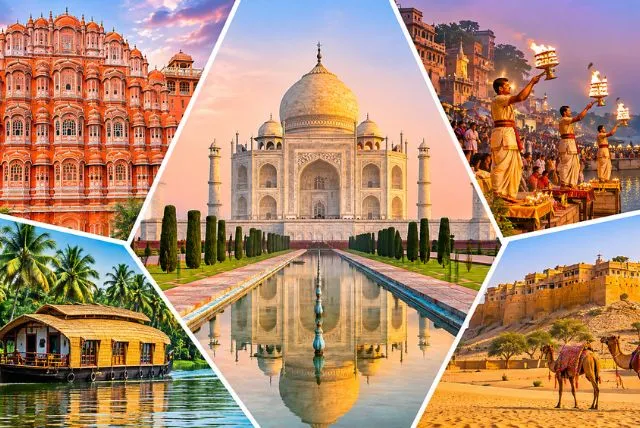
The best India travel itinerary for most first-time visitors is the 7-day Golden Triangle: Delhi (2 nights), Agra (2 nights) and Jaipur (2 nights). With 10 days, add Varanasi. With 14 days, choose either a deeper Rajasthan route or a North India plus Kerala trip. With 21 days, you can combine North and South India without rushing.
India is huge, and that is the main planning problem. Cities that look close on a map can be a 5–8 hour journey apart. This guide gives you six routes by trip length, with recommended nights, travel times, transport options and the mistakes to avoid. If you are still deciding where to go, start with our guide to the best places to visit in India, then come back here to turn your shortlist into a route.
India Travel Itinerary at a Glance
Use this table to pick a route quickly. The rest of the article gives the day-by-day detail.
| Trip length | Route | Suggested nights | Best months | Best for |
|---|---|---|---|---|
| 5 days | Delhi – Agra – Jaipur | Delhi 1–2, Agra 1, Jaipur 2 | Oct–Mar | Short trips |
| 7 days | Golden Triangle | Delhi 2, Agra 2, Jaipur 2 | Oct–Mar | First-time visitors |
| 10 days | Golden Triangle + Varanasi | Delhi 2, Agra 2, Jaipur 2, Varanasi 3 | Oct–Mar | Culture lovers |
| 14 days | North India (Varanasi + Amritsar or Udaipur) | Delhi 3, Agra 2, Jaipur 3, Varanasi 2, extension 2 | Oct–Mar | Heritage explorers |
| 14 days | Rajasthan royal circuit | 2+ nights in each major stop | Oct–Mar | Couples, palaces, photography |
| 10–14 days | Kerala and South India | Kochi 2, Munnar 2, Thekkady 2, Alleppey 2, beach 2 | Oct–Mar (driest Dec–Mar) | Nature lovers, slow travel |
| 21 days | North and South India | See the 21-day plan below | Oct–Mar | Complete exploration |
How Many Days Do You Need in India?
Most travellers need at least a week for a satisfying first trip. Here is what is realistic at each length.
Is 5 Days Enough for India?
Five days is enough for a quick Golden Triangle if you arrive early and keep to Delhi, Agra and Jaipur. Do not add anything else. You will spend roughly a day in transit, so treat it as a taster.
Is 7 Days Enough for India?
Seven days is the sweet spot for a first visit. You can see Delhi, the Taj Mahal and Jaipur at a comfortable pace, with room for Fatehpur Sikri or a market morning.
Is 10 Days Enough for India?
Ten days works well if you add one extra region. Varanasi is the most common choice because it feels very different from the Golden Triangle. Udaipur is the main alternative.
Is 14 Days Enough for India?
Two weeks lets you go deeper into one region, such as Rajasthan, or combine the Golden Triangle with Varanasi and one more stop. A North plus South trip is possible, but it needs at least one internal flight and a rest day afterwards.
Is 3 Weeks Enough to Explore India?
Three weeks is the first length where North and South India combine comfortably. You still will not see everything, and that is fine. A good rule is no more than 4–5 bases in 14 days, and one night in a place is rarely worth the packing.
5-Day India Travel Itinerary: Delhi, Agra and Jaipur
Day 1: Arrive in Delhi
Keep the first day light, especially after a long-haul flight. If you have energy, visit India Gate, Humayun’s Tomb or Connaught Place. Qutub Minar also fits here.
Day 2: Delhi to Agra
Take a morning train or drive to Agra (about 200 km). Visit Agra Fort in the afternoon and watch the sunset from Mehtab Bagh, which looks across the river to the Taj Mahal.
Day 3: Taj Mahal and Travel to Jaipur
Visit the Taj Mahal at sunrise, then travel to Jaipur (about 240 km, 4–5 hours by road). Use the evening for a gentle walk or dinner.
Day 4: Jaipur’s Historic Attractions
Start early at Amber Fort, then see the City Palace, Jantar Mantar and the Hawa Mahal façade.
Day 5: Jaipur and Departure
Spend the morning at the bazaars, then fly out of Jaipur or return to Delhi. Allow for the return journey of roughly 4–6 hours, depending on mode.
Transport and Accommodation
Use the train for Delhi–Agra and a private car for Agra–Jaipur. Stay near the Taj Mahal in Agra to make a sunrise visit easy. Check that your Agra day does not fall on a Friday, because the Taj Mahal is closed.
7-Day India Travel Itinerary: The Classic Golden Triangle
This is the route most first-time visitors should choose. It adds a second night in Delhi and Agra, which gives you time to recover from the flight and avoid back-to-back transfers.
Days 1–2: Discover Delhi
- Old Delhi: Jama Masjid, Red Fort and the lanes of Chandni Chowk for street food.
- New Delhi: India Gate and Humayun’s Tomb.
- Tip: Take a guided food walk if you want to eat street food with confidence.
Days 3–4: Explore Agra
- Taj Mahal: Go at sunrise. It opens about 30 minutes before sunrise and closes about 30 minutes before sunset, and it is closed every Friday.
- Agra Fort and Mehtab Bagh for sunset views.
- Fatehpur Sikri (optional): a good stop on the way to Jaipur if you have a private car.
Days 5–6: Experience Jaipur
- Amber Fort early in the morning, before the crowds.
- City Palace, Hawa Mahal and Jantar Mantar.
- Local markets for textiles, jewellery and crafts.
Day 7: Return to Delhi or Depart from Jaipur
If you fly home from Delhi, leave Jaipur early or take a morning train so you have buffer time. If your flight leaves from Jaipur, you can sleep in and enjoy a last bazaar visit.
Delhi to Agra to Jaipur: Distance and Travel Time
| Leg | Distance | Train | Road | Flight |
|---|---|---|---|---|
| Delhi to Agra | About 200 km | About 1 hr 40 min (Gatimaan Express or Vande Bharat) | 3–4 hrs | Not practical |
| Agra to Jaipur | About 240 km | About 3.5–5 hrs | 4–5 hrs | Not practical |
| Jaipur to Delhi | About 260–280 km | About 4–5.5 hrs | 5–6 hrs | About 1 hr (air time) |
The Delhi–Agra train is the clear winner. Agra–Jaipur is better by car, because you can stop at Fatehpur Sikri or Chand Baori on the way.
Where to Stay
In Delhi, stay in a central area such as Connaught Place or near Humayun’s Tomb. In Agra, stay close to the Taj Mahal for an easy sunrise visit. In Jaipur, the old city is atmospheric but busy, while the areas just outside are calmer.
Tips for Planning the Golden Triangle
- Plan around the Friday closure of the Taj Mahal.
- Foreign visitor tickets: The official Taj Mahal site lists ₹1,100, plus an optional ₹200 for the main mausoleum, with children under 15 free. Prices change, so confirm on the official Taj Mahal website before you travel.
- Keep a travel buffer. Aim for no more than 6–8 hours of travel in a day.
- Book trains early in the October–March peak season.
10-Day India Travel Itinerary: Golden Triangle and Varanasi
Add Varanasi to the Golden Triangle for a very different experience: the ghats, the river and the city’s spiritual atmosphere.
- Days 1–2: Delhi
- Days 3–4: Agra
- Days 5–6: Jaipur
- Days 7–9: Varanasi: Dashashwamedh Ghat, the evening Ganga Aarti, a sunrise boat ride, Kashi Vishwanath Temple and a half-day at Sarnath.
- Day 10: Return to Delhi and depart
How to Travel Between Jaipur and Varanasi
Varanasi is roughly 780 km from Agra, which is too far for a comfortable road day. On a 10-day trip, fly. Flights usually take 1–2 hours, but check whether your route goes direct or via Delhi. Varanasi to Delhi can also be done by train (around 8 hours on the Vande Bharat), but a flight of about 1.5 hours saves a lot of energy.
Another option is to fly Delhi to Varanasi first and finish in Jaipur or Delhi. Either way, book flights early and confirm the current schedule.
14-Day India Travel Itinerary: Explore North India
This route builds on the 10-day plan. It gives you two options for the final stop, so choose one rather than trying to fit both.
- Days 1–3: Delhi (including a recovery day)
- Days 4–5: Agra
- Days 6–8: Jaipur
- Days 9–10: Varanasi
- Days 11–12: Amritsar or Udaipur
- Days 13–14: Return and departure
Choose Amritsar if you want the Golden Temple and a northern, Punjabi flavour. Choose Udaipur for lakes and palaces. Either adds a flight or a long transfer, so keep it to two nights at least.
14-Day Rajasthan Itinerary: India’s Royal Heritage
Rajasthan suits travellers who prefer depth over variety. The route is mostly by road, which makes it a good match for a private driver.
- Days 1–2: Jaipur
- Day 3: Pushkar and Ajmer
- Days 4–5: Jodhpur: Mehrangarh Fort and the blue old town.
- Days 6–7: Jaisalmer: the golden fort and a desert evening.
- Days 8–10: Udaipur: City Palace, Lake Pichola and the old town.
- Days 11–14: Extra time and departure. Use these days for a slower pace, another stop such as Bundi or Ranthambore, or the Golden Triangle at the start or end.
How to Travel Around Rajasthan
A private car and driver is the most practical option. Jodhpur to Jaisalmer is a substantial drive of around five hours. Jodhpur to Udaipur is about 250 km and roughly 5.5 hours if you stop at Ranakpur Jain Temple. Trains and short flights can fill gaps, but road is simplest.
If you have only 10 days, drop either Pushkar or Jaisalmer. Wildlife parks such as Ranthambore need separate bookings through official sources.
Best Time to Visit Rajasthan
October to March is the practical window, with warm days and cool nights. Summer is very hot, especially in the desert.
10–14-Day Kerala and South India Itinerary
Kerala is slower and greener than the north. It suits couples, families and anyone who wants beaches, hills and backwaters without constant sightseeing.
- Days 1–2: Kochi: Fort Kochi, Chinese fishing nets and a Kathakali performance.
- Days 3–4: Munnar: tea plantations and hill views. The drive from Kochi is around 125 km and takes about 4 hours.
- Days 5–6: Thekkady: spice gardens and wildlife.
- Days 7–8: Alleppey backwaters: a houseboat stay.
- Days 9–10: Varkala or Marari Beach: beach time to finish. Alleppey to Varkala takes roughly 2.5 hours.
Optional Extensions for 14 Days
- More beach days
- Kumarakom
- Cultural experiences such as cooking classes
Transport and Houseboat Planning
Fly into Kochi and use road transfers. Houseboats range from basic to luxury, so compare what is included (meals, overnight stay, crew) before you book.
Best Time to Visit Kerala
October to March is generally the most comfortable window, and December to March is typically the driest. June to September is monsoon, which can suit green-season travellers but may disrupt outdoor plans.
21-Day India Itinerary: North and South India
Three weeks lets you combine the Golden Triangle, Varanasi and Kerala. This chart shows how the days are split.
21-day India route: days allocated to each stop
Orange = North India, green = South India, grey = transit and rest. Day counts come from the itinerary below.
- Days 1–3: Delhi
- Days 4–5: Agra
- Days 6–8: Jaipur
- Days 9–11: Varanasi
- Days 12–13: Travel to Kerala and rest. Fly south and keep these days light.
- Days 14–15: Kochi
- Days 16–17: Munnar
- Days 18–19: Alleppey
- Days 20–21: Goa or a Kerala beach before departure
Plan at least one internal flight between North and South India, and allow a low-activity day after each flight. Confirm routes, airlines and timings close to your travel date.
Best Time to Visit India for Your Itinerary
October to March is the best window for most routes in this guide. For ideas that suit the cooler months, see our list of places to visit in India in winter.
| Region | Best months | Watch out for |
|---|---|---|
| Delhi, Agra, Jaipur | Oct–Mar | Fog in Dec–Jan can delay trains and flights; extreme heat Apr–Jun; monsoon Jun–Sep |
| Rajasthan | Oct–Mar | Very hot summers, especially in the desert |
| Varanasi | Oct–Mar | Hot late spring and monsoon rain |
| Kerala | Oct–Mar (driest Dec–Mar) | Heavy rain Jun–Sep |
Winter (October to March)
Winter is peak season for North India and Rajasthan. Days are pleasant and nights are cool, but prices and demand are highest, especially from November to February and around Christmas and New Year. Book trains, flights and hotels early.
Summer (April to June)
Summer is very hot across the northern plains. It is a poor time for the Golden Triangle and Rajasthan.
Monsoon (June to September)
Monsoon timing varies by region. It is heavy in Kerala and brings humidity to the north. Fewer visitors means lower prices, but outdoor plans can be disrupted.
Festivals Worth Planning Around
Diwali falls on 8 November 2026, and demand rises sharply around it. Holi, the Pushkar Camel Fair, Durga Puja and Onam move with the lunar calendar, so confirm the exact dates with official state tourism or recognised calendar sources before you book. Festival periods can mean higher prices and fully booked trains and hotels.
How to Travel Around India
Travelling by Train
Trains are excellent for short and mid-length legs. Useful services include the Gatimaan Express and Vande Bharat Express (fast daytime trains), the Shatabdi Express (daytime intercity) and overnight trains for longer journeys. Book through IRCTC.
Indian Railways also has a Foreign Tourist Quota of reserved seats, bookable at International Tourist Bureau counters including New Delhi, with your passport and visa. See the Indian Railways guidance for details.
Travelling by Domestic Flight
Flights make sense for long legs such as Delhi to Varanasi, North to South India, or Udaipur back to Delhi. They are fast, but airport time adds up, and winter fog can cause delays.
Hiring a Private Driver
A driver is the easiest way to see Rajasthan and to stop at places like Fatehpur Sikri. It is also a good choice for families, older travellers and solo travellers who prefer not to take late trains. Daily rates are not standardised, so compare quotes and check what is included.
Travelling by Bus
Buses are cheap and cover places trains do not reach, but they are slower and less comfortable. Most first-time visitors can skip them on these routes.
Train vs Flight vs Private Car
| Option | Best for | Drawbacks |
|---|---|---|
| Train | Delhi–Agra, Delhi–Jaipur, budget travel, the local experience | Popular trains sell out; delays are possible |
| Domestic flight | Long legs (Varanasi, Kerala, return to Delhi) | Airport time; fog delays in winter |
| Private car and driver | Rajasthan, flexible stops, families | Higher cost; long road days |
How Much Does an India Trip Cost?
There is no single official daily budget for India, and prices vary widely by travel style, season and city. Rather than quote unreliable averages, use the factors below to build your own estimate, then check current prices before booking.
| Cost area | What changes the price | Where to check |
|---|---|---|
| Accommodation | Hostel and guesthouse, heritage or boutique hotel, or palace hotel; peak season and festivals | Hotel booking sites and direct hotel quotes |
| Transport | Train class, flights, private driver by the day | IRCTC, airline sites, driver quotes |
| Food | Local restaurants and street food versus hotel dining | Menus and recent traveller reports |
| Sightseeing | Foreign visitor tickets cost more than domestic. Taj Mahal: ₹1,100 plus an optional ₹200 for the mausoleum | tajmahal.gov.in |
As a rule, your biggest savings come from travelling in the shoulder months, taking trains for short legs and booking early. Your biggest costs are palace hotels, internal flights and private drivers for long routes. Carry a mix of a card and some cash, and use ATMs at banks where possible.
Essential Things to Know Before Planning
India Visa and e-Visa Requirements
Most visitors, including those from the UK, US, Australia and Canada, can apply for an e-Visa. Apply only on the official site, indianvisaonline.gov.in. The e-Tourist visa is available for 30 days, one year or five years, and you can apply online and receive an electronic travel authorisation by email. Apply at least four days before arrival, and make sure your passport has at least six months’ validity and two blank pages. Fees depend on nationality and rules change, so see the official site and the Incredible India visa guide.
How to Book Indian Train Tickets
Create an account on IRCTC, search your route, and book as early as the booking window allows. If standard seats are full, ask about the Foreign Tourist Quota.
Health, Safety and Insurance
Check the latest UK FCDO travel advice for India before you travel, and get advice from a travel health clinic about vaccinations. Take out travel insurance that covers medical care and cancellations.
Money, SIM Cards and Etiquette
Use official exchange counters or bank ATMs. A local SIM or eSIM helps with maps and booking apps. Dress modestly at temples and mosques, and remove your shoes where asked.
Useful Apps and What to Pack
Useful apps include IRCTC for trains, an airline app, a maps app and a ride-hailing app. Pack light layers for cool winter mornings, sun protection, comfortable walking shoes and a scarf for temple visits.
Best India Itinerary for Your Travel Style
| Traveller | Best route | Why |
|---|---|---|
| First-time visitors | 7-day Golden Triangle | Iconic sights, simple logistics |
| Couples and honeymooners | Rajasthan, or Golden Triangle + Kerala | Palaces, lakes, backwaters and beaches |
| Families | Golden Triangle or Kerala at a slower pace | Fewer long transfers; private driver for flexibility |
| Solo travellers | Golden Triangle + Varanasi | Well-trodden route; use a private driver rather than late trains |
| Budget travellers | 10–14 days by train | Same core stops using Gatimaan, Shatabdi and Vande Bharat services |
| Train travellers | Delhi–Agra–Jaipur–Varanasi | Mix of fast day trains and one flight |
| Older travellers | Rajasthan or Kerala | Slower pace, longer stays, fewer changes |
Common Mistakes to Avoid
- Trying to visit too many cities. One-night stops waste time on packing and transfers.
- Underestimating travel times. Traffic and delays make a 5-hour journey feel longer.
- Ignoring the weather. Summer heat and winter fog can disrupt plans.
- Not checking closure days. The Taj Mahal is closed on Fridays.
- Booking trains late. Popular services sell out in peak season.
- Skipping arrival-day rest. Jet lag makes day one harder than it looks.
- Leaving no buffer between flights and transfers. Add a cushion before an international departure.
Frequently Asked Questions About India Travel Itineraries
What is the best India travel itinerary for first-time visitors?
The 7-day Golden Triangle (Delhi, Agra, Jaipur) is the best starting point. It is easy to organise and covers the best-known sights.
How many days are enough to explore India?
One week covers a single region. Two weeks gives you depth or a second region. Three weeks lets you combine North and South India.
What is the best 7-day itinerary for India?
Two nights in Delhi, two in Agra and two in Jaipur, with a final day for departure.
Can you explore India in 10 days?
Yes, if you limit yourself to one region plus one extension. The Golden Triangle with Varanasi is the most popular choice.
Is 14 days enough to visit India?
It is enough for a rich first trip: North India highlights, a Rajasthan circuit, or a Golden Triangle plus Kerala route with a flight between them.
What is the best 2-week India itinerary?
For heritage, choose the 14-day Rajasthan route. For variety, choose the 14-day North India route. For nature and slow travel, choose Kerala.
How much does a 2-week trip to India cost?
It depends mainly on your hotels, internal flights and whether you hire a driver. Use the cost table above and check current prices before you book.
What is the best month to visit India?
For most routes, October to March. Kerala is driest from December to March.
Is it better to travel around India by train or flight?
Use trains for shorter legs like Delhi to Agra and flights for long legs like Varanasi or Kerala.
Can you travel around India without a private driver?
Yes. The Golden Triangle works well with trains, and flights can cover the long legs. A driver is most useful in Rajasthan.
Is India suitable for solo travellers?
Many people travel solo in India. Stick to well-trodden routes, arrange transfers in advance, avoid late-night train arrivals, and read the official FCDO advice.
What should I avoid when planning an India trip?
Avoid packing in too many cities, travelling in the hottest months, and forgetting the Taj Mahal’s Friday closure.
Final Thoughts: Plan Your India Travel Itinerary
Choose your route by how much time you have, not by how much you want to see. Seven days suits the Golden Triangle. Ten days adds Varanasi. Fourteen days is for Rajasthan, North India or Kerala. Three weeks lets you combine North and South at a relaxed pace.
Before you book, confirm train timetables, Taj Mahal fees, visa rules and festival dates on official sources, because they change. For more destination ideas, browse our guide to the best places to visit in India.
This guide is based on official and published sources, including the Taj Mahal website, the Indian e-Visa portal, Indian Railways and Incredible India. Prices, timetables and rules can change, so verify them before you travel.