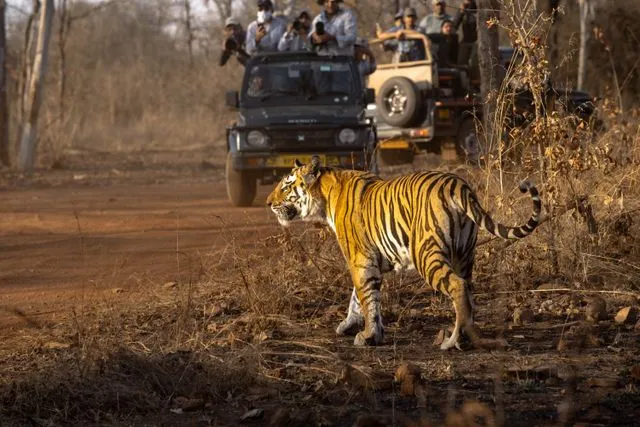
The best wildlife safaris in India depend on the animal you want to see. For tigers, go to Bandhavgarh, Tadoba, Ranthambore or Jim Corbett. For Asiatic lions, go to Gir. For one-horned rhinos, go to Kaziranga. For leopards, try Jawai. For wild elephants, head to Nagarhole (Kabini). Most tiger parks are best from October or November to June, and you should book on the official state forest portal.
No guide can promise a sighting. Wild animals move freely, so the best way to improve your chances is to pick the right park, travel in the right season and book two or three safaris. This guide covers 18 parks, with real figures, a month-by-month calendar, official booking steps and costs.
Quick Pick: Best Safari for Each Animal
| Animal you want to see | Best parks | Best months |
|---|---|---|
| Tiger | Bandhavgarh, Tadoba, Ranthambore, Jim Corbett, Kanha | October–June |
| Asiatic lion | Gir (Gujarat) | 16 October–15 June |
| One-horned rhino | Kaziranga, Manas (Assam) | November–April |
| Leopard | Jawai (Rajasthan), Satpura, Nagarhole | October–April |
| Asian elephant | Nagarhole (Kabini), Bandipur, Periyar | October–May |
| Birds and wetlands | Keoladeo (Bharatpur), Sundarbans | October–March |
| Boat safari | Sundarbans, Periyar, Satpura | Winter for Sundarbans |

Best Wildlife Safaris in India at a Glance
| Park | State | Best known for | Typical best months | Safari type |
|---|---|---|---|---|
| Bandhavgarh | Madhya Pradesh | Tigers, fort | Oct–Jun | Jeep |
| Ranthambore | Rajasthan | Tigers, fort ruins | Oct–Jun | Jeep, canter |
| Tadoba-Andhari | Maharashtra | Tigers | Oct–Jun | Jeep |
| Jim Corbett | Uttarakhand | Tigers, elephants | Nov–Jun | Jeep, canter |
| Kanha | Madhya Pradesh | Tigers, barasingha | Oct–Jun | Jeep |
| Pench | Madhya Pradesh / Maharashtra | Tigers, Jungle Book links | Oct–Jun | Jeep |
| Satpura | Madhya Pradesh | Walking, boat, canoe | Oct–Jun | Jeep, walking, boat |
| Panna | Madhya Pradesh | Tiger comeback, river | Oct–Jun | Jeep, boat |
| Gir | Gujarat | Asiatic lions | Oct–Jun | Jeep |
| Kaziranga | Assam | One-horned rhinos | Nov–Apr | Jeep |
| Jawai | Rajasthan | Leopards | Oct–Apr | Jeep |
| Nagarhole (Kabini) | Karnataka | Elephants, leopards | Oct–May | Jeep, boat |
| Bandipur | Karnataka | Elephants, tigers | Oct–May | Jeep, bus |
| Keoladeo | Rajasthan | Birds | Oct–Mar | Cycle, rickshaw, walk |
| Sundarbans | West Bengal | Mangroves, tigers | Nov–Feb | Boat |
| Periyar | Kerala | Lake, elephants | Oct–May | Boat, walk |
| Manas | Assam | Rhinos, golden langurs | Nov–Apr | Jeep, boat |
| Dudhwa | Uttar Pradesh | Swamp deer, tigers | Nov–Jun | Jeep |
Where the 18 parks in this guide are located
Source: The Adventure Trip park list, grouped by region.
Central India has the most tiger parks, so it is the easiest place to plan a first trip. The north suits a short trip from Delhi. The south is the best region for elephants.
How to Choose the Right Safari
Start with the animal, then check the season and how far you are willing to travel. Three terms help you read park pages:
- National park or tiger reserve: government-run, with a permit system on an official forest portal. Most parks in this guide are in this group.
- Core and buffer zone: the core is the most protected area. Buffer zones are around it and often stay open when the core is shut. Sightings are possible in both.
- Community or private area: Jawai is the main example. It has no government permit portal, and jeeps are arranged through local camps and operators.
Safari vehicles differ too. An open jeep (Gypsy) holds up to six people and is better for photos. A canter is a 20-seat open bus that costs less per person but is shared and louder. Boat, canoe and walking safaris are offered in a few places, such as Satpura, Sundarbans and Periyar. Tourist elephant rides are being phased out in many parks for welfare reasons, so do not plan around them.
Best Tiger Safaris in India
India is home to most of the world’s wild tigers. The 2022 All India Tiger Estimation counted 3,682 tigers, up from 1,411 in 2006. Madhya Pradesh has the most, which is why Central India is the top region for tiger safaris.
Where India’s tigers live (2022 estimate)
Source: All India Tiger Estimation 2022 (NTCA / WII). Total: 3,682.
India’s tiger population over time
Source: National Tiger Conservation Authority (NTCA), All India Tiger Estimation cycles.
1. Bandhavgarh National Park, Madhya Pradesh: best for a tiger-focused trip
Bandhavgarh is small and hilly, with an ancient fort above the forest. It is known for a high density of tigers, so many photographers and repeat visitors choose it. You may also see leopards, sambar, wild boar and many birds. Jeep safaris run in several zones, including Tala, Magadhi and Khitauli, and you can book on the Madhya Pradesh forest portal.
- Reach: nearest railway station is Umaria, about 35 km away. Jabalpur and Khajuraho are the nearest main airports.
- Best for: tiger-first trips and photography.
2. Ranthambore National Park, Rajasthan: best for tigers and history
Ranthambore is the best-known tiger park in India. Tigers sometimes walk past 10th-century fort walls, lakes and ruined pavilions, which makes for unusual photos. You can choose a six-seat jeep or a 20-seat canter, and the park is split into zones 1 to 10. Rajasthan reopened the park for the 2026–27 season on 1 October 2026, with the season reported to run to 30 June 2027. Fees were raised by about 10 per cent in April 2026, so check the live price before you budget. The park is busy, and zones such as Zone 3 can get crowded with vehicles.
- Reach: Sawai Madhopur railway station is about 10 km away. Jaipur airport is about 180 km away.
- Best for: first-timers and short trips from Delhi or Jaipur.

3. Tadoba-Andhari Tiger Reserve, Maharashtra: best for good tiger photography
Tadoba is Maharashtra’s oldest national park and is popular for tiger sightings in open dry forest and around lakes. It usually feels quieter than the biggest Madhya Pradesh parks. Sloth bears, leopards and wild dogs also live here. Safaris are by jeep in both core and buffer zones. May and June are very hot, often above 40°C, but waterholes draw animals out.
- Reach: Nagpur is the nearest airport, about 140 km away. Chandrapur is the nearest railway station.
- Best for: photographers and Mumbai or Pune travellers who fly to Nagpur.
4. Jim Corbett National Park, Uttarakhand: best for foothill scenery near Delhi
Corbett is India’s oldest national park, founded in 1936. It has sal forest, grassland and the Ramganga river, and it is known for tigers and elephants. The Dhikala zone, with its forest rest house, is the most sought-after, so book it early. Jeep and canter safaris are both available, and some zones open in stages after the monsoon.
- Reach: about 250 km from Delhi, roughly six hours by road.
- Best for: families and first-timers who have only a weekend.
5. Kanha National Park, Madhya Pradesh: best for scenery and variety
Kanha has wide meadows and tall sal trees, so it feels like a classic Indian jungle. It is the best place to see the hard-ground barasingha, a rare swamp deer saved from near extinction. Tigers, gaur, wild dogs and many birds live here too. Jeep safaris cover zones such as Kanha, Kisli, Mukki and Sarhi.
- Reach: Jabalpur is the usual gateway, about 160 km away.
- Best for: families and anyone who likes landscapes as much as tigers.
6. Pench National Park, Madhya Pradesh and Maharashtra: best for value
Pench is linked with Rudyard Kipling’s The Jungle Book. Its teak forests, streams and hills are home to tigers, leopards, dhole and sloth bears. It is usually more affordable than the headline tiger parks and sits close to Nagpur.
- Reach: Nagpur is about 90 km from the Maharashtra side.
- Best for: budget travellers and combined Kanha and Pench trips.
7. Satpura Tiger Reserve, Madhya Pradesh: best for walking and canoe safaris
Satpura is one of the few places where you can leave the jeep. Walking safaris in permitted areas, canoe trips on the Denwa river and boat rides give a quieter and closer feel to the forest. Tigers live here, but you are more likely to see sloth bears, leopards, gaur and birds. Check which activities the official portal currently allows.
- Reach: Pipariya is the nearest major railway station, and Bhopal is the main airport.
- Best for: couples and travellers who want an unhurried, less crowded trip.
8. Panna National Park, Madhya Pradesh: best for river scenery and a conservation story
Panna lost all its tigers in the 2000s and then recovered after a reintroduction programme from 2009. The Ken river, gorges and plateau make it one of the prettiest parks in the state. It also sits near Khajuraho, so you can add temples to the trip.
- Reach: Khajuraho airport and railway station are the nearest hubs.
- Best for: culture lovers who want to pair wildlife with a heritage stop.
Best Lion, Rhino, Leopard and Elephant Safaris
9. Gir National Park, Gujarat: best for Asiatic lions
Gir is the only wild home of the Asiatic lion. The 2025 census counted 891 lions in Gujarat, up from 674 in 2020 and 327 in 2001. Most Gir safaris use open jeeps on 35 km forest routes, and you may also see leopards, chital, sambar and crocodiles. Gir’s official page lists three safari time slots: winter morning and afternoon sessions, plus a mid-day session, with the park shut from 16 June to 15 October each year.
Asiatic lion numbers in Gujarat
Source: Gujarat Forest Department lion censuses, as released in May 2025.
Where Gujarat’s 891 lions live (2025)
Source: Gujarat Forest Department 2025 census, as reported in the press. The lion range now spreads well beyond Gir.
- Book: only on the official Gir portal, girlion.gujarat.gov.in. The site warns about fake booking sites.
- Reach: Sasan Gir is 60 km from Junagadh, 45 km from Veraval and about 160 km from Rajkot. Keshod is the nearest airport at 60 km.
- Best for: families and anyone who wants a unique species.

10. Kaziranga National Park, Assam: best for one-horned rhinos
Kaziranga is a UNESCO World Heritage Site and holds most of the world’s greater one-horned rhinos. Assam’s 2022 census counted 2,613 rhinos here, up from 2,413 in 2018. Tall grass, wetlands, wild elephants, water buffalo and many birds make the park very photogenic. Jeep safaris run across ranges such as Kohora, Bagori and Agaratoli. Floods close the park in the monsoon, and the reopening date can change, so check the official Assam notice.
- Reach: Jorhat airport is about 97 km away. Guwahati is about 217 km away.
- Best for: rhino lovers and bird photographers. Plan two to three days to cover more than one range.

11. Jawai, Rajasthan: best for leopards
Jawai is a landscape of granite hills, caves and a reservoir, where leopards live close to Rabari herders. Sightings of leopards on rocks at dawn and dusk are the main draw. It is not a conventional national park. There is no single government permit portal, and jeeps are usually arranged through local camps and operators, so compare options and ask what is included. The terrain is rocky, so it is a less comfortable ride for people with back problems.
- Reach: Udaipur is the nearest airport, about 135 km away. Falna is the nearest railway station.
- Best for: leopard photography and an off-the-beaten-track trip.

12. Nagarhole National Park (Kabini), Karnataka: best for elephants
Nagarhole, also called Rajiv Gandhi National Park, borders the Kabini reservoir. In the dry months, large herds of Asian elephants come to the water’s edge, and you can watch them on jeep or boat safaris. Leopards, gaur and dhole live here as well, and Kabini is also known for sightings of a black leopard.
- Reach: about 220 km from Bengaluru, roughly five hours by road. Mysuru is closer.
- Best for: elephants and weekend trips from Bengaluru.

13. Bandipur National Park, Karnataka: best for southern forest scenery
Bandipur is part of the Nilgiri Biosphere Reserve and neighbours Nagarhole. Dry deciduous forest and hills hold elephants, gaur, tigers and leopards. Choose Bandipur if you want to cover the Nilgiris region, and Nagarhole if you want the lake and elephant herds.
- Reach: about 80 km from Mysuru and about 220 km from Bengaluru.
- Best for: combining wildlife with the Nilgiris or Wayanad.
Best Birdwatching and Boat Safaris
14. Keoladeo National Park, Rajasthan: best for birds
Keoladeo, also known as Bharatpur Bird Sanctuary, is a UNESCO World Heritage wetland. You explore it on foot, by cycle or by cycle rickshaw, with a guide who knows where the birds are. Winter brings migratory ducks, geese and raptors alongside resident storks, herons and owls.
- Reach: about 55 km from Agra and about 180 km from Delhi.
- Best for: relaxed, low-cost wildlife days and birders.

15. Sundarbans National Park, West Bengal: best for a mangrove boat safari
The Sundarbans is part of the world’s largest mangrove forest and a UNESCO site. You travel by boat through tidal creeks to look for crocodiles, kingfishers, deer and monitor lizards. Tigers live here, but sightings are rare, so go for the atmosphere rather than a guaranteed big cat. Permits, boats and guides are arranged through registered operators or West Bengal tourism, so use official channels.
- Reach: about three hours by road from Kolkata to the boarding points.
- Best for: a different kind of safari and a short trip from Kolkata.

16. Periyar Tiger Reserve, Kerala: best for a lake and spice-hills trip
Periyar is built around a lake in the Western Ghats. Boat cruises are the main draw, and elephants and gaur often come to drink at the shore. Guided walks and bamboo rafting are offered in some parts, which suits families. Tiger sightings are rare, but the scenery and the nearby spice plantations make up for it.
- Reach: Thekkady town is the base. Madurai and Kochi are the nearest airports.
- Best for: families and slow, scenic travel.
17. Manas National Park, Assam: best for rare wildlife and quiet trails
Manas lies on the Bhutan border and is a UNESCO World Heritage Site. Grasslands and forests shelter rhinos, elephants, tigers and rare golden langurs. It is far less visited than Kaziranga, so it suits travellers who prefer a quiet visit. Check the current access and safari options with Assam’s forest department before you plan.
- Reach: about 140 km from Guwahati.
- Best for: second parks in an Assam trip.
18. Dudhwa National Park, Uttar Pradesh: best for Terai grassland
Dudhwa protects tall Terai grassland, swamp deer, tigers and reintroduced rhinos. It is quiet, with few other visitors. Lucknow is the easiest hub, so it works best as a trip for travellers who like to avoid crowds.
- Reach: Lucknow is about 215 km away.
- Best for: repeat visitors who want a quieter park.
Best Wildlife Safari in India by Traveller Type
| If you are… | Pick | Why |
|---|---|---|
| A first-timer | Ranthambore or Jim Corbett | Easy to reach, good facilities, jeep and canter choices |
| Travelling with children | Kanha, Corbett or Periyar | Scenic, well set up, and not too long on the road. Check age rules at each park |
| A photographer | Bandhavgarh, Tadoba or Jawai | Good light, open habitat and strong tiger or leopard reputation |
| A couple | Satpura or Panna | Quiet, scenic, with walking, boat and river options |
| On a budget | Pench, Tadoba or Keoladeo | Lower costs and plenty of canter or cycle options |
| After a luxury stay | Ranthambore, Bandhavgarh or Jawai | Wide choice of high-end lodges and camps |
| Near Delhi | Jim Corbett, Ranthambore, Keoladeo | Reachable by road or rail in half a day |
| Near Mumbai or Pune | Tadoba or Pench via Nagpur | Fly to Nagpur, then drive about two to three hours |
| Near Bengaluru | Nagarhole (Kabini) or Bandipur | About five hours by road |
| Near Kolkata | Sundarbans | About three hours by road to the boat points |
If you want to add beaches or cities to your wildlife trip, our guide to the best beaches in India pairs well with a Kabini or Gir safari.
Best Time for Wildlife Safaris in India
The main season is October to June. Winter (October to February) is cooler and good for birds. Summer (March to June) is hot, but forests dry out and animals visit waterholes, which can make big cats easier to spot. Monsoon (July to September) closes most core zones and floods the north-east, so plan around it.
Park open and closed calendar (typical)
| Park | Jan | Feb | Mar | Apr | May | Jun | Jul | Aug | Sep | Oct | Nov | Dec |
|---|---|---|---|---|---|---|---|---|---|---|---|---|
| Ranthambore | Open | Open | Open | Open | Open | Open | Shut | Shut | Shut | Open | Open | Open |
| Bandhavgarh / Kanha / Pench | Open | Open | Open | Open | Open | Open | Ltd | Ltd | Ltd | Open | Open | Open |
| Tadoba | Open | Open | Open | Open | Open | Open | Ltd | Ltd | Ltd | Open | Open | Open |
| Jim Corbett | Open | Open | Open | Open | Open | Ltd | Ltd | Ltd | Ltd | Ltd | Open | Open |
| Gir | Open | Open | Open | Open | Open | Open | Shut | Shut | Shut | Shut | Open | Open |
| Kaziranga | Open | Open | Open | Open | Shut | Shut | Shut | Shut | Shut | Shut | Open | Open |
| Jawai | Open | Open | Open | Open | Open | Open | Open | Open | Open | Open | Open | Open |
| Nagarhole / Bandipur | Open | Open | Open | Open | Open | Ltd | Ltd | Ltd | Ltd | Open | Open | Open |
| Sundarbans | Open | Open | Open | Ltd | Ltd | Ltd | Ltd | Ltd | Ltd | Open | Open | Open |
| Keoladeo | Open | Open | Open | Ltd | Ltd | Ltd | Ltd | Ltd | Ltd | Open | Open | Open |
Typical patterns: Open = main zones open; Ltd = limited or some zones only; Shut = closed. Based on official park pages and notices; confirm each year. Gir’s official closure is 16 June–15 October.
Planning for the cooler months? See our guide to places to visit in India in winter for ideas to combine with a safari.
How to Book a Wildlife Safari in India
Book only on the official forest department or ecotourism portal for each park. Many fake sites charge extra, and Gir’s official site warns about them. Here is the usual process:
- Choose a park and zone. Zones differ in scenery and crowds. You cannot always pick your zone, and a zone does not guarantee a sighting.
- Open the official portal. Examples: Rajasthan’s forest department for Ranthambore, Gujarat’s Gir portal for Gir, and Assam’s forest department for Kaziranga.
- Pick a date and slot. Most parks offer a morning and an afternoon safari.
- Choose a jeep or canter. A jeep is better for photos. A canter costs less.
- Enter visitor details and ID. Indian visitors use a government photo ID. Foreign visitors use a passport.
- Pay the permit and charges. Some parks charge guide and vehicle fees separately.
- Carry the original ID and booking. Use the same ID you booked with.
How far ahead should you book?
Book as early as the portal allows, especially for weekends, Diwali, Christmas and New Year. Popular zones in Ranthambore, Corbett and Gir sell out quickly. Gir does not sell last-minute (tatkal) permits on its website.
Core zone or buffer zone?
Core zones are the most protected and usually closed in the monsoon. Buffer zones are less strictly managed and often open all year. Both can give good sightings, and buffer zones are often quieter.
What if a safari is cancelled?
Rules differ by state and park. Read the cancellation and refund terms on the portal before you pay, and note the weather and park closure rules.
Foreign visitors also need a valid Indian e-Visa before travel, applied for on the official Indian visa site (indianvisaonline.gov.in). Check the rules close to your travel date.
Wildlife Safari Cost in India
There is no single national price. Each state sets its own permit, guide and vehicle charges, and Indian and foreign visitors pay different rates. Gir publishes a clear price list, so it is a useful example. These figures were checked on the official Gir page, last updated 9 November 2026.
Gir jungle safari permit price (per vehicle, up to 6 people)
Source: girlion.gujarat.gov.in, checked 9 November 2026. Permit only. Guide and vehicle are extra.
| Gir jungle safari item | Indian visitors | Foreign visitors |
|---|---|---|
| Permit, Monday–Friday (up to 6 people) | ₹800 | ₹7,600 |
| Permit, weekend and festival days | ₹1,000 | ₹9,500 |
| Extra child, Monday–Friday | ₹100 | ₹1,900 |
| Extra child, weekend and festival days | ₹125 | ₹2,375 |
| Safari vehicle (paid separately) | ₹2,500 (4-seat), ₹3,500 (6-seat), ₹4,500 (8-seat) | Same vehicle rates |
| Guide | Paid separately | Paid separately |
Worked example: four Indian visitors on a weekday pay ₹800 for the permit and ₹2,500 for a four-seat vehicle, which is ₹3,300 plus the guide. Four foreign visitors pay ₹7,600 plus ₹2,500, which is ₹10,100 plus the guide.
For other parks, check the live portal. Fees change often. For example, Ranthambore raised its rates by about 10 per cent in April 2026. Three tips to keep costs down:
- Share a canter instead of booking a private jeep.
- Book weekdays, as weekend permits cost more in parks such as Gir.
- Stay in a town near the gate rather than in a luxury lodge, and book transport early.
Do not rely on third-party price lists. Budget for the permit, vehicle, guide, camera charge where it applies, a place to stay, food and transport to the park.
How to Reach the Parks from Major Cities
| Starting city | Parks to consider | Typical route and time |
|---|---|---|
| Delhi | Jim Corbett, Ranthambore, Keoladeo | Corbett is about 250 km (around six hours by road). Ranthambore is reached via Sawai Madhopur railway station. Keoladeo is about 180 km |
| Mumbai or Pune | Tadoba, Pench | Fly or take a train to Nagpur, then drive about two to three hours |
| Bengaluru | Nagarhole (Kabini), Bandipur | About 220 km, roughly five hours by road |
| Kolkata | Sundarbans | About three hours by road to the boarding points |
| Guwahati | Kaziranga, Manas | Kaziranga is about 217 km. Manas is about 140 km |
| Ahmedabad or Rajkot | Gir | Rajkot is about 160 km from Sasan Gir. Ahmedabad is about 370 km |
| Jabalpur or Nagpur | Kanha, Bandhavgarh, Pench | Jabalpur is the usual base for Kanha. Nagpur is the base for Pench |
For a longer route that includes cities and culture, see our India travel itinerary.
Multi-Park Safari Circuits
- Madhya Pradesh tiger circuit (6–8 days): Bandhavgarh, Kanha and Pench, with Satpura or Panna as an add-on. Plan long road transfers between parks.
- Rajasthan (4–5 days): Ranthambore and Jawai, or add Keoladeo for birds on the way from Delhi.
- Uttarakhand (2–3 days): Jim Corbett as a standalone trip from Delhi.
- Assam (4–5 days): Kaziranga and Manas, starting from Guwahati.
- South India (4–6 days): Nagarhole, Bandipur and Periyar.
Leave a free half-day between parks. Two or three safaris in each park are a better plan than rushing between parks.
Safari Rules and Responsible Travel
- Follow your guide and the forest department’s instructions at all times.
- Never feed or call out to animals, and stay in the vehicle where it is required.
- Keep noise low and do not use flash photography.
- Do not fly drones. They need written permission and are not allowed for tourists in national parks and tiger reserves.
- Carry no plastic where it is banned, and do not litter.
- Respect local communities, and choose licensed guides and camps.
- Check each park’s age limits and dress rules before you go.
What to Pack for a Wildlife Safari
- Clothes: earth-toned layers. Winter mornings in open jeeps are cold, so bring a jacket, scarf and gloves.
- Footwear: closed, comfortable shoes.
- Equipment: binoculars and a camera with a zoom lens.
- Protection: sunscreen, a hat and insect repellent.
- Documents: the original ID used for booking, plus your booking confirmation.
- Summer: a water bottle, cap and light cotton clothes.
Frequently Asked Questions About Wildlife Safaris in India
Which is the best wildlife safari in India?
It depends on the animal. Ranthambore and Bandhavgarh are top choices for tigers, Gir for lions, Kaziranga for rhinos, Jawai for leopards and Kabini for elephants.
Which national park has the best tiger sightings?
No park can promise a sighting. Bandhavgarh, Tadoba, Ranthambore and Jim Corbett are popular for tigers. Book two or three safaris to improve your chances.
What is the best time for wildlife safaris in India?
October to June for most parks. Kaziranga is best from November to April, and Gir is open from 16 October to 15 June.
How much does a wildlife safari cost in India?
It varies by park and nationality. At Gir, an Indian group of up to six pays ₹800 for a weekday permit, plus vehicle and guide. A foreign group pays ₹7,600.
Which safari is best for first-time visitors?
Ranthambore and Jim Corbett. Both have good facilities and are easy to reach from Delhi.
Which park is best for families?
Kanha, Jim Corbett and Periyar are good choices. Check each park’s age rules first.
Where can you see Asiatic lions?
Only in Gujarat, mainly in and around Gir National Park. The 2025 census counted 891 lions.
Where can you see one-horned rhinos?
Kaziranga is the best place. Manas also has rhinos, and Assam’s 2022 census counted 2,613 in Kaziranga.
Where is the best leopard safari in India?
Jawai in Rajasthan is the most popular leopard area, with Satpura and Nagarhole as other options.
Are wildlife safaris in India safe?
Yes, when you follow your guide and the park rules. Stay in the vehicle where required and never approach animals.
How can I book a jungle safari in India?
Use the official forest department portal for the park. Avoid third-party sites that add extra fees.
How many safaris should I book?
Two or three per park. This lets you see different zones and light, but it still does not guarantee a sighting.
Are elephant safaris available?
Rare. Kaziranga’s official page lists morning elephant safaris, but many parks have phased out tourist rides for welfare reasons. Check the current rules.
Are parks open during the monsoon?
Most core zones close from about July to September or October. Some buffer zones stay open. Gir is closed from 16 June to 15 October.
Can foreign tourists book safaris?
Yes. They need a passport, a valid Indian visa and the passport details on the portal. They pay higher permit fees than Indian visitors.
Which safari is best near Delhi?
Jim Corbett and Ranthambore. Keoladeo is a good add-on for birds.
Which safari is best near Mumbai?
Tadoba and Pench, via a flight or train to Nagpur.
Can children join a safari?
Often yes, but age limits and rules vary by park and by zone. Check before you book.
Final Thoughts: Which Safari Should You Choose?
Pick the animal first. Choose Bandhavgarh, Tadoba or Ranthambore for tigers, Gir for lions, Kaziranga for rhinos, Jawai for leopards, Kabini for elephants and Keoladeo for birds. Then match the park to your season, budget and travel time, and book through the official portal.
Wildlife safaris are only one part of the country. For more ideas, read our list of the best places to visit in India, or explore more guides on The Adventure Trip. Go with respect, follow park rules and accept that every sighting is a bonus.
Sources and Official Links
- National Tiger Conservation Authority: ntca.gov.in (tiger estimates and reserves).
- Gir permit prices and rules: girlion.gujarat.gov.in (checked 9 November 2026).
- Ranthambore booking: Rajasthan Forest Department.
- Kaziranga and Assam booking: Assam Forest Department.
- Kaziranga overview: Incredible India.
- Lion census 2025: Gujarat Forest Department figures, as reported by national media in May 2025.
Fees, dates and rules can change. Check the official portal on the day you book.
1 thought on “Best Wildlife Safaris in India: 18 Top Parks, Costs and Booking (2026–27)”